
When building healthcare analytics, every healthcare leader wants the same thing: clear, trusted answers available when decisions are being made. Few organizations disagree about the destination. The real question is how to get there.
An organization can build every component from scratch, or it can start with a foundation already engineered for healthcare and adapt it to its data, workflows, and priorities. Both approaches can produce a tailored analytics environment. What changes is how much foundational work must be completed before the organization can focus on using the insights.
That is the value of a healthcare analytics accelerator. It does not replace customization. It reduces the need to recreate common components, allowing implementation teams to concentrate on what is distinctive about the organization.
Building Healthcare Analytics: Where the Time Goes in a Custom Build
Teams usually develop dashboards near the end of a healthcare analytics implementation, even though users see them as the most visible part of the environment.
Before teams can design what users see, they must identify the right data, understand where it resides, determine how it should be prepared, and agree on what each measure means across the organization.
- For healthcare providers, this may involve bringing together clinical, financial, revenue cycle, scheduling, staffing, and operational data.
- For healthcare payers, it can include claims, member, eligibility, provider network, utilization, quality, and financial information.
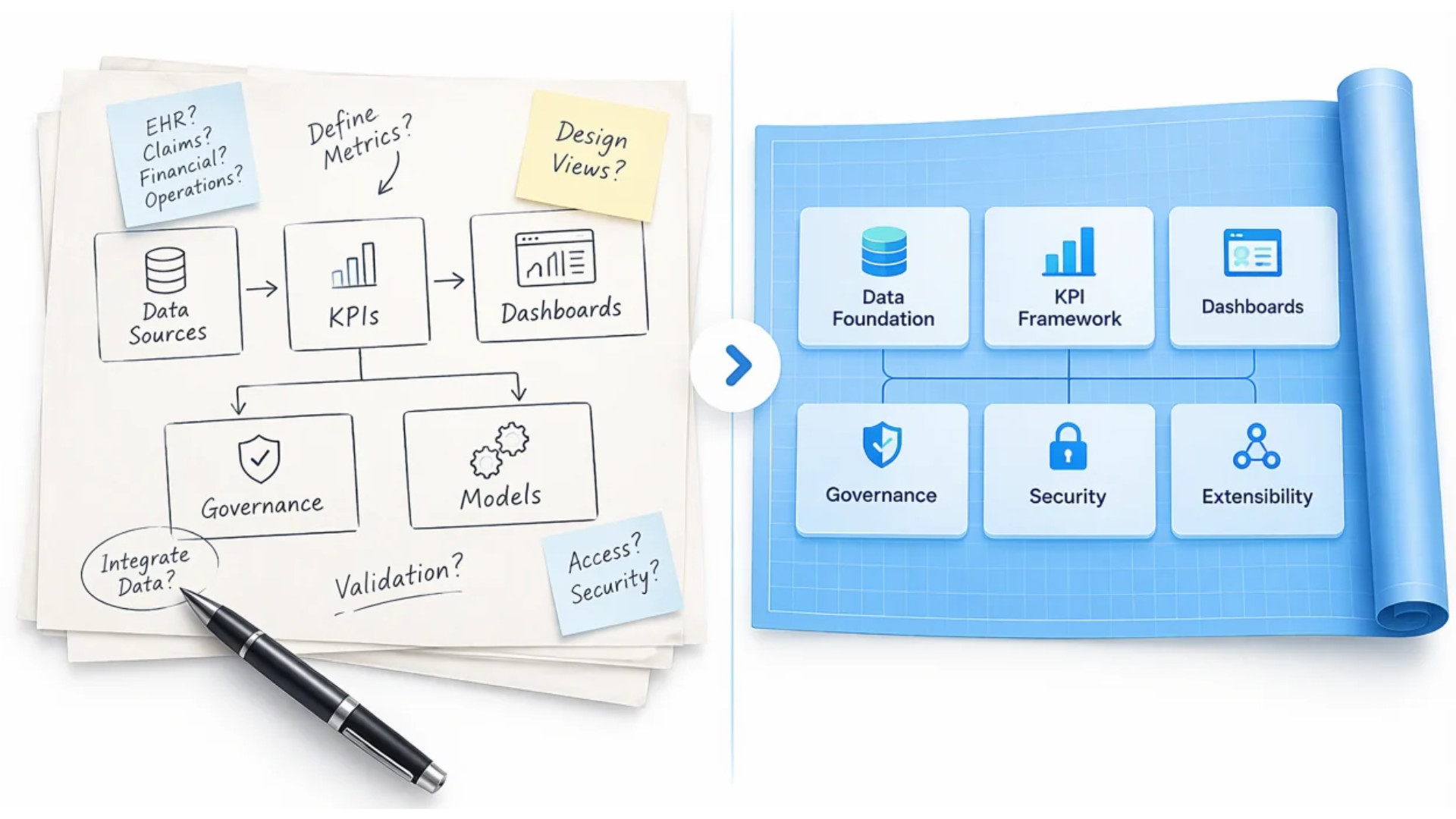
Teams must connect, map, and prepare these sources before using them for consistent analysis. As the data is prepared, the work also includes:
- Defining KPIs and agreeing on calculation methods.
- Developing data and reporting models.
- Establishing appropriate access and governance for the information.
- Validating the accuracy and consistency of the resulting information.
- Designing dashboards around the different decisions made by executives, department leaders, analysts, and operational teams.
None of this work is unnecessary. The question is how much of it needs to begin with a blank page. In a custom build, implementation teams can spend much of their early effort creating foundational components before turning their attention to the analytics requirements that are distinctive to the organization.
Healthcare Analytics Implementation: How the Starting Point Changes the Work
The goal may be the same, but the starting point is different. A custom build creates each component around the organization’s requirements. An accelerator begins with common healthcare analytics components already in place, allowing more of the effort to go into validating, configuring, and extending them.

The comparison below shows how the two approaches differ across the areas that most directly influence time to value.
| Area | Build from Scratch | Start with an Accelerator |
|---|---|---|
| Data foundation | Design data structures, integrations, and reporting models from the ground up. | Start with prebuilt structures and integration patterns, then adapt them to the organization’s systems and data. |
| KPI framework | Define each KPI, calculation method, and reporting rule. | Begin with healthcare-focused KPIs, then validate them against the organization’s definitions. |
| Dashboards | Define the requirements, layouts, measures, and user experience from a blank page. | Configure prebuilt dashboards around the decisions different users need to make. |
| Provider and payer needs | Define and model clinical, operational, financial, claims, member, utilization, and network requirements. | Adapt provider- and payer-focused components to the organization’s specific use cases. |
| Implementation effort and time to first insight | Build the common foundation and organization-specific capabilities together. Insights depend on more of that underlying work being completed. | Focus more effort on data mapping, validation, workflows, and distinctive requirements. Dashboards and measures can be reviewed from an earlier stage. |
| Risk and rework | Design and test foundational assumptions for the first time. | Review, validate, and adapt established components rather than define everything from zero. |
| Future expansion and AI readiness | Plan for additional data sources and use cases while building the data and governance foundation needed for AI. | Extend the same data foundation as analytics priorities evolve and prepare it for AI and predictive use cases. |
Starting ahead does not mean accepting a fixed analytics solution. Source systems still need to be connected, measures validated, access configured, and dashboards adapted to the way different teams work.
What Starting Ahead Looks Like with VNB Health
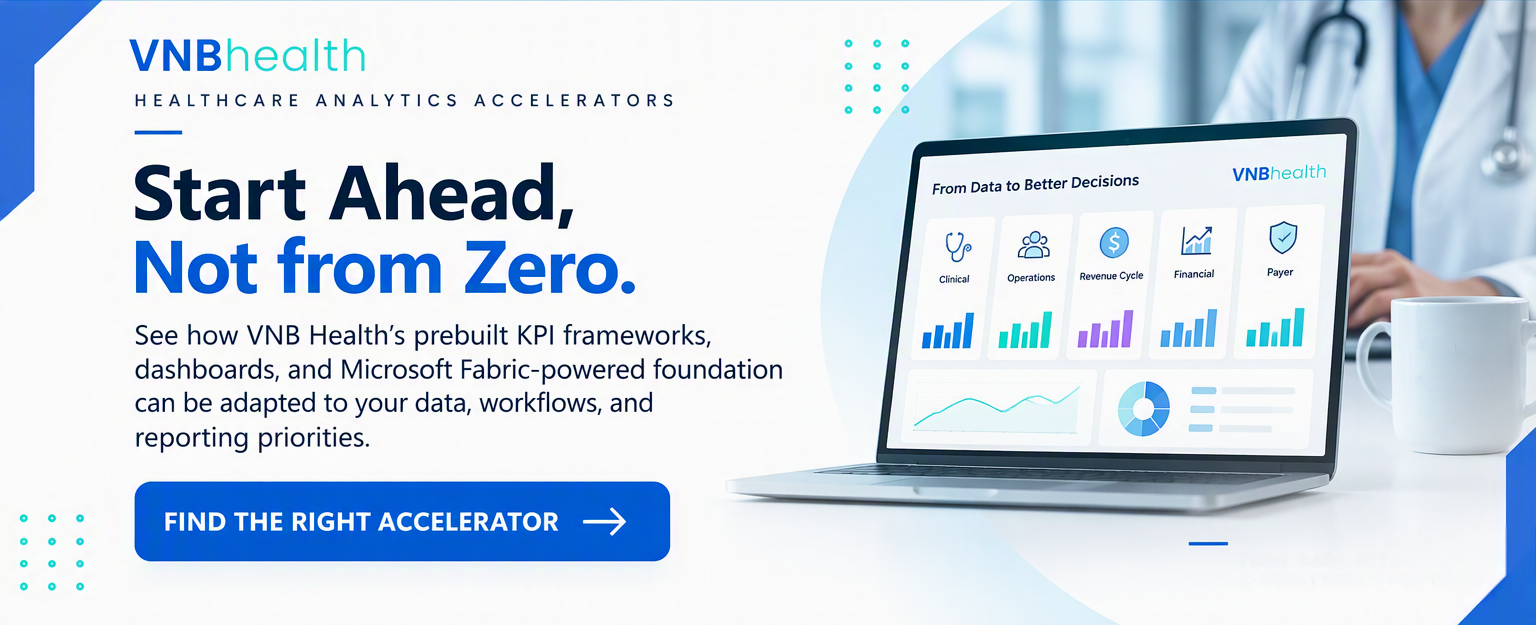
A healthcare analytics accelerator becomes valuable when it reflects the decisions healthcare organizations actually need to make. When building healthcare analytics, providers and payers need a starting point that can be adapted to their systems, workflows, measures, and priorities. VNB’s healthcare analytics accelerators apply this approach across clinical, operational, financial, revenue cycle, and payer analytics.
Each accelerator starts with:
Healthcare KPI frameworks. Predefined performance metrics, executive scorecards, operational measures, and value-based care measures provide a consistent starting point for reporting. Instead of beginning with “what should we measure?”, teams can validate and adapt established definitions to the organization’s reporting requirements and priorities.
Executive and operational dashboards. Role-based views reflect how different teams use analytics. Executive leaders can review enterprise performance, financial health, and strategic KPIs. Department leaders can examine service-line performance and trends, while operations teams can monitor daily activity, exceptions, and actionable insights.
A unified Microsoft Fabric data platform. The platform brings data integration, enterprise reporting, governance, security, analytics engineering, and future AI enablement into one scalable environment built on Microsoft Fabric and Power BI.
Connectivity across the healthcare data ecosystem. The foundation is designed to work with EHR and EMR platforms such as Epic, Cerner, athenaOne, eClinicalWorks, NextGen, and Allscripts, along with practice management systems, billing platforms, and clearinghouses.
Accelerators for Key Healthcare Priorities
The core architecture remains consistent, while each accelerator applies the KPIs, dashboards, reporting views, and data structures to different provider and payer priorities.
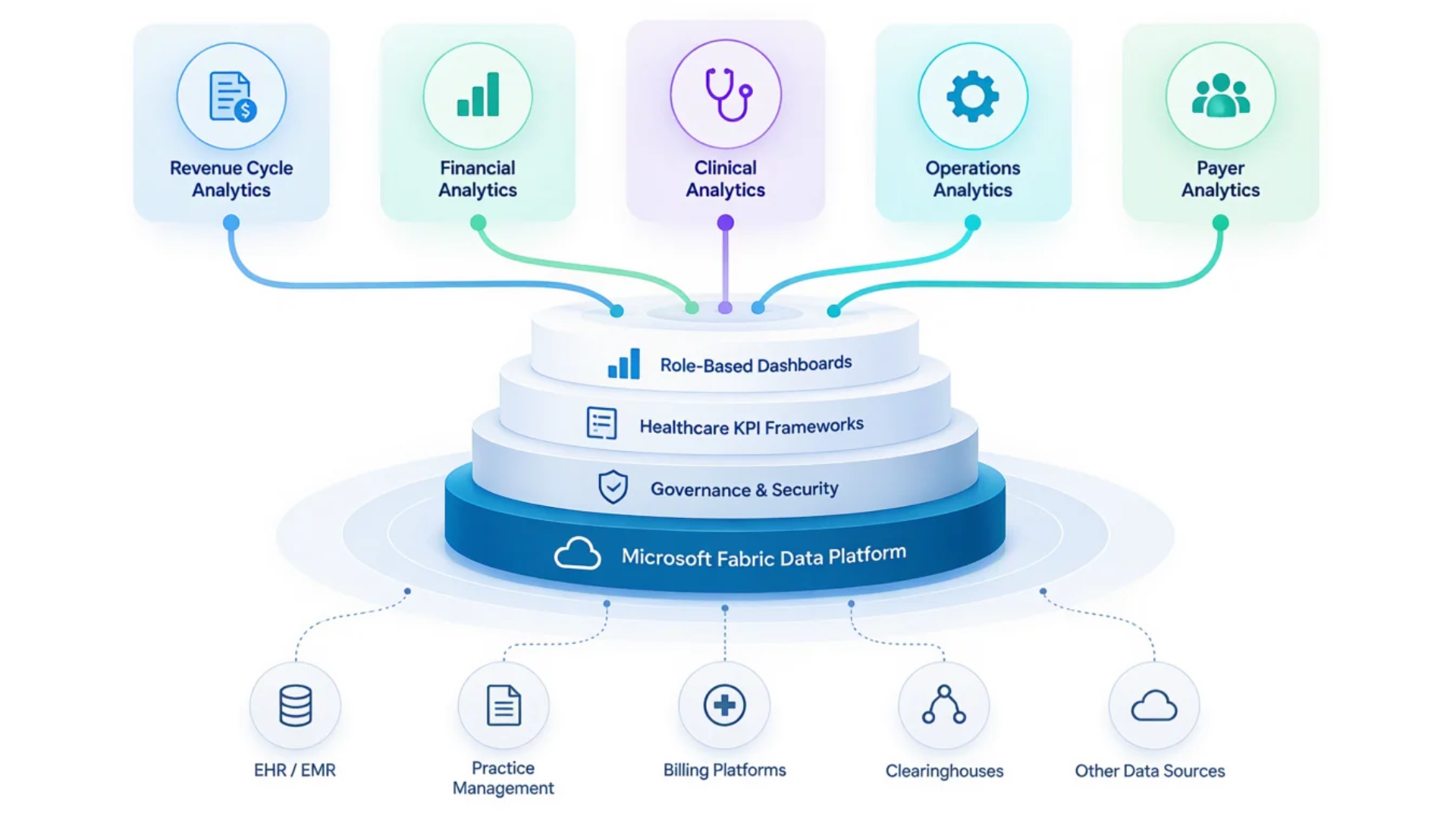
Revenue Cycle Analytics: Monitor accounts receivable, denials, reimbursement, and revenue leakage to strengthen collections and cash flow.
Financial Analytics: Bring revenue, costs, margins, budget variance, and profitability together for more informed planning.
Clinical Analytics: Analyze clinical quality, patient outcomes, care variation, physician performance, and population health to support better care decisions.
Operations Analytics: Track patient flow, capacity, scheduling, wait times, and resource utilization to manage daily operations.
Payer Analytics: Evaluate claims, member populations, utilization, quality, cost, and provider network performance to support plan and population-level decisions.
A Stronger Starting Point for What Comes Next
Building healthcare analytics is not only about the dashboards organizations need today. New data sources, reporting requirements, predictive analytics, AI, and automation will continue to expand what teams expect from their analytics environment.
That makes the starting point important. A governed foundation with consistent KPIs, connected data, and adaptable reporting structures gives healthcare providers and payers something they can continue to build on as their needs change.
An accelerator is not the finished answer. It is a practical head start, one that allows teams to address the priorities in front of them without losing sight of what may come next.