
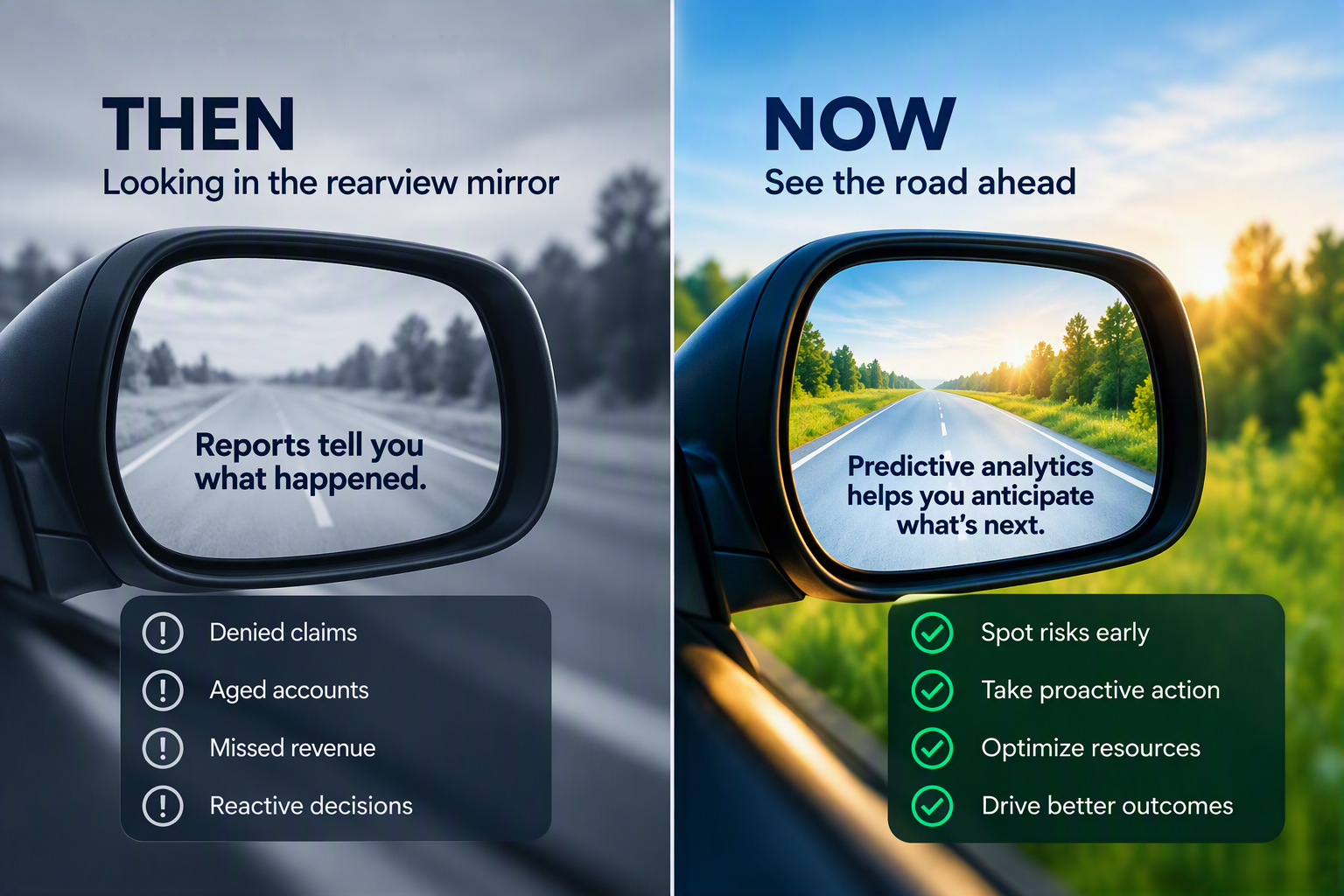
A healthy revenue cycle is critical to the financial stability of any healthcare organization. Yet delayed payments, claim denials, and unpredictable cash flow keep the pressure on revenue cycle teams. Reports reveal claim denials, accounts that have aged past 90 days, and cash-flow shortfalls, but only after these problems have affected financial performance. Predictive analytics in healthcare revenue cycle management helps uncover those signals so providers can anticipate risks and prioritize action.
What Predictive Analytics Means in Healthcare
Revenue cycle teams already have a record of what gets paid, what gets denied, and how long collections take. Predictive analytics uses statistical modeling and machine learning to look for patterns in that history and estimate what may happen next. This gives healthcare organizations a more proactive approach to revenue cycle management.
Which claims face a higher risk of denial? Could an account remain unpaid beyond 90 days? Predictive analytics can even identify appointment slots that may go unfilled.
With tight margins and complex administrative processes, healthcare organizations have good reason to ask these questions. Addressing a potential reimbursement issue is often easier than resolving it after payment has been affected.
These estimates aren’t guarantees. They help staff decide what needs attention, while leaving the judgment about what to do with the people who know the work.
How Predictive Analytics Changes Revenue Cycle Management
The most important change predictive analytics brings to revenue cycle management (RCM) is not another dashboard – it is timing. Traditional RCM follows a familiar pattern: a payer denies a claim, someone investigates the issue, reworks and resubmits the claim, and then waits weeks for payment. Predictive analytics moves that effort earlier, to the point where problems are still cheap to fix.
At registration, predictive analytics can flag eligibility gaps and missing authorizations early, before they surface as denials later in the process.
Before submission, a predictive analytics model can identify claims with a higher risk of denial. Historical data may reveal that claims involving certain payers, procedures, coding combinations, or authorization requirements are more likely to be returned. The model can score each claim’s denial risk, letting staff correct issues pre-billing. Correcting these issues before submission can improve clean claim rates, reduce rework, and prevent avoidable delays in reimbursement.
After billing, accounts vary in balance, age, payment history, and likelihood of collection. A predictive model can help teams identify which accounts may need early outreach or a conversation about payment support and which can follow the usual reminder cycle. This allows staff to focus on cases where timely intervention may have the greatest impact.
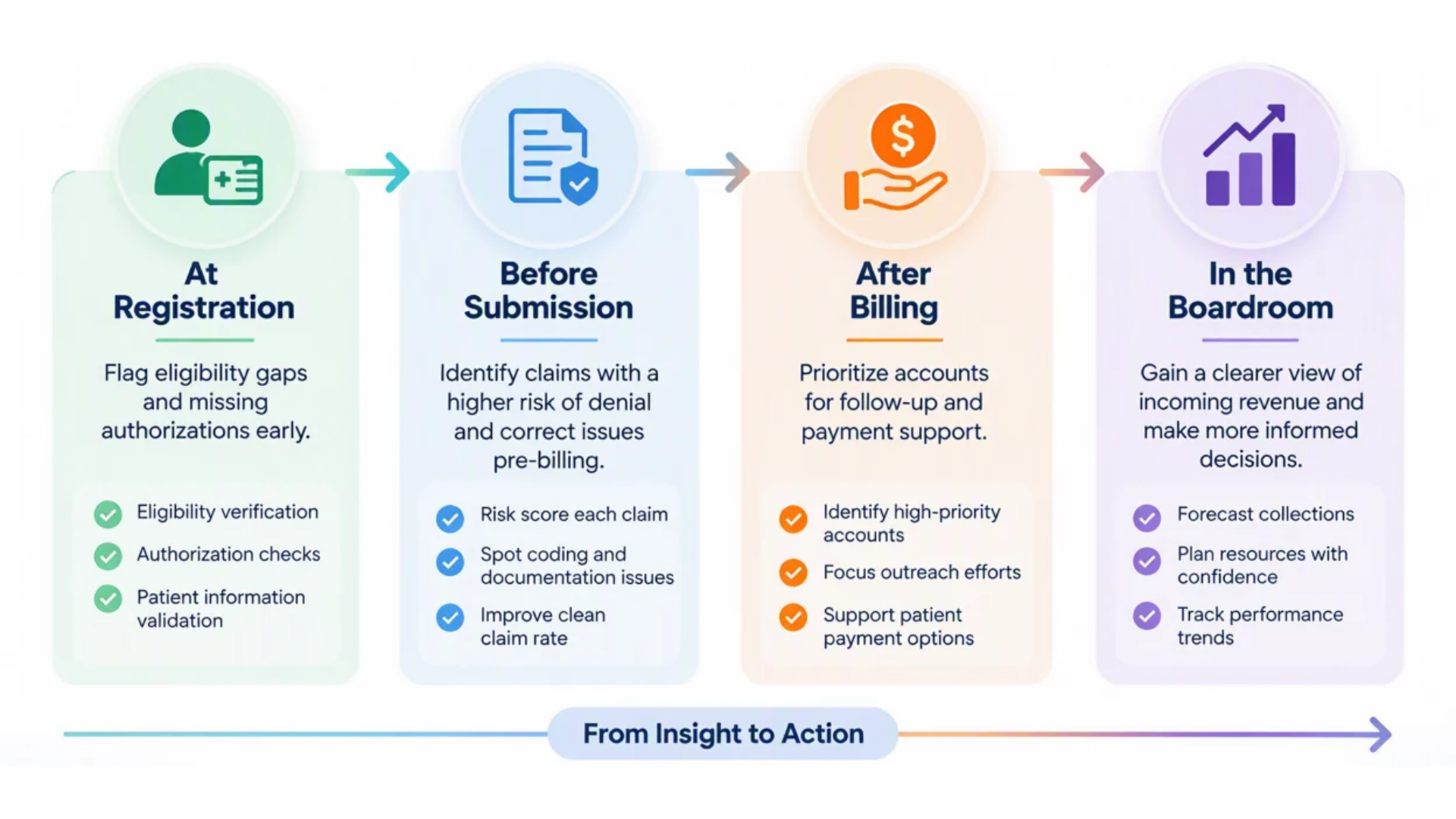
In the boardroom, forecasting changes too. Payment timelines vary by payer and claim type, making collections difficult to predict. Predictive analytics uses past payment behavior and open claims to give leaders a clearer view of incoming revenue and a stronger basis for budgeting and resource planning.
Put simply, this is not about predicting every outcome with certainty. It is about knowing where risk concentrates, so experienced staff can spend their time on the claims and accounts where a timely intervention actually changes the outcome.
Where Things Get Tricky
Building the model is only part of the challenge. The harder work often lies in everything around it: the data feeding it, the people using it, and the environment in which it operates.
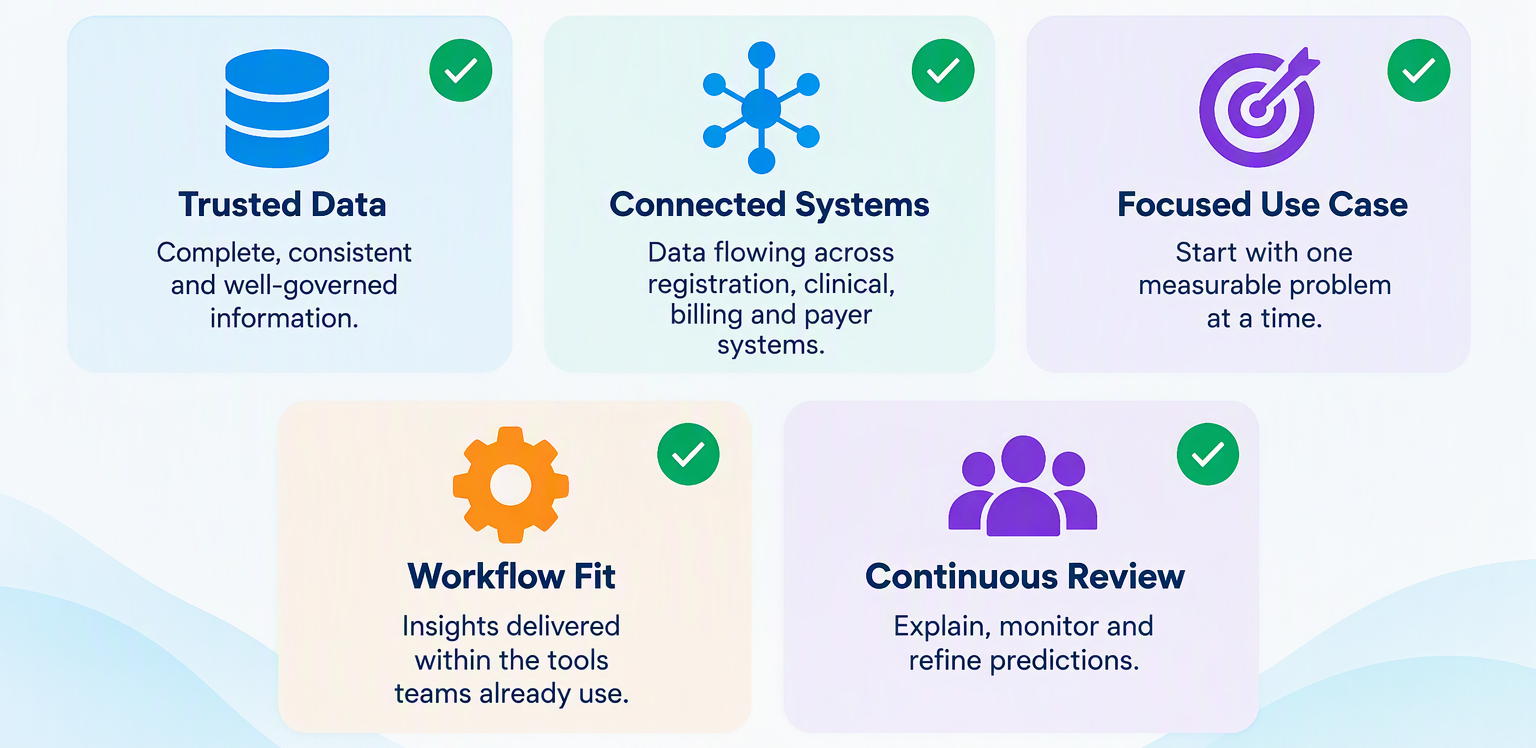
A healthcare revenue cycle predictive analytics strategy is only as reliable as the data behind it. Incomplete or inconsistent records can cause a model to produce unreliable predictions. Therefore, before any model is built, organizations must get serious about data governance and interoperability, making sure data flows cleanly between registration, clinical, billing, and payer systems. Since all these stages touch patient information, HIPAA compliance cannot be an afterthought; it must be built into the architecture from the beginning.
It’s also tempting to start too big. Trying to predict every denial, delay, and payment risk at once can make a project difficult to manage. The smarter approach is to start small: pick one well-defined problem, like flagging claims likely to be denied, and prove value there first. A focused pilot gives teams something tangible to measure and refine while building confidence before expanding.
Then there’s the human factor, which is where most analytics projects very quietly fail. A risk score on a separate dashboard changes little if staff can’t use it while working a claim or following up on an account. Predictive insights need to fit within the tools teams already use. Staff need to understand why the model flagged something rather than simply follow an unexplained recommendation.
As payer rules and patient behavior change, prediction models can become less reliable. Regular monitoring and periodic retraining are essential, with experienced revenue cycle professionals checking that predictions still make sense.
The Next Step: Acting on Predictive Insights
A prediction helps most when the right person sees it in time to act. If a claim looks likely to be denied, staff need to know why. Is an authorization missing? Is there a coding issue or a payer-specific requirement? Knowing the reason helps them fix the problem before the claim goes through another round of denial and resubmission.
This is where intelligent automation can help with the follow-through. It can handle routine follow-ups, send complex cases to experienced staff, and flag urgent issues sooner. Generative AI and natural language processing (NLP) could also help teams review clinical documentation and prepare first drafts of appeals. And with real-time analytics, providers can start conversations about costs and payment support earlier in the patient journey. That can mean fewer surprises when the bill arrives and more time for patients to make sense of their options.
For any of this to work, teams need to trust the model’s recommendations. They’re more likely to act when they understand why something was flagged, rather than being asked to take the model’s word for it.
Looking Ahead
Predictive analytics will not solve every revenue cycle challenge, and it won’t replace the people who manage the process. What it can do is help healthcare organizations spot risks earlier, focus limited resources where they matter most, and make decisions with a clearer view of what may be coming.