
Healthcare organizations do not need more data. They already have more than enough of it. What they need is greater confidence in the information they already collect. Healthcare analytics with Microsoft Fabric can connect fragmented clinical, financial, and revenue cycle data to create a trusted foundation for reporting and decision-making.
Every department has a report. Not every department has the same truth!
Healthcare organizations generate clinical, revenue cycle, financial, and operational data every day. But it often lives in different systems, follows different definitions, and must be manually reconciled before anyone can trust the numbers.
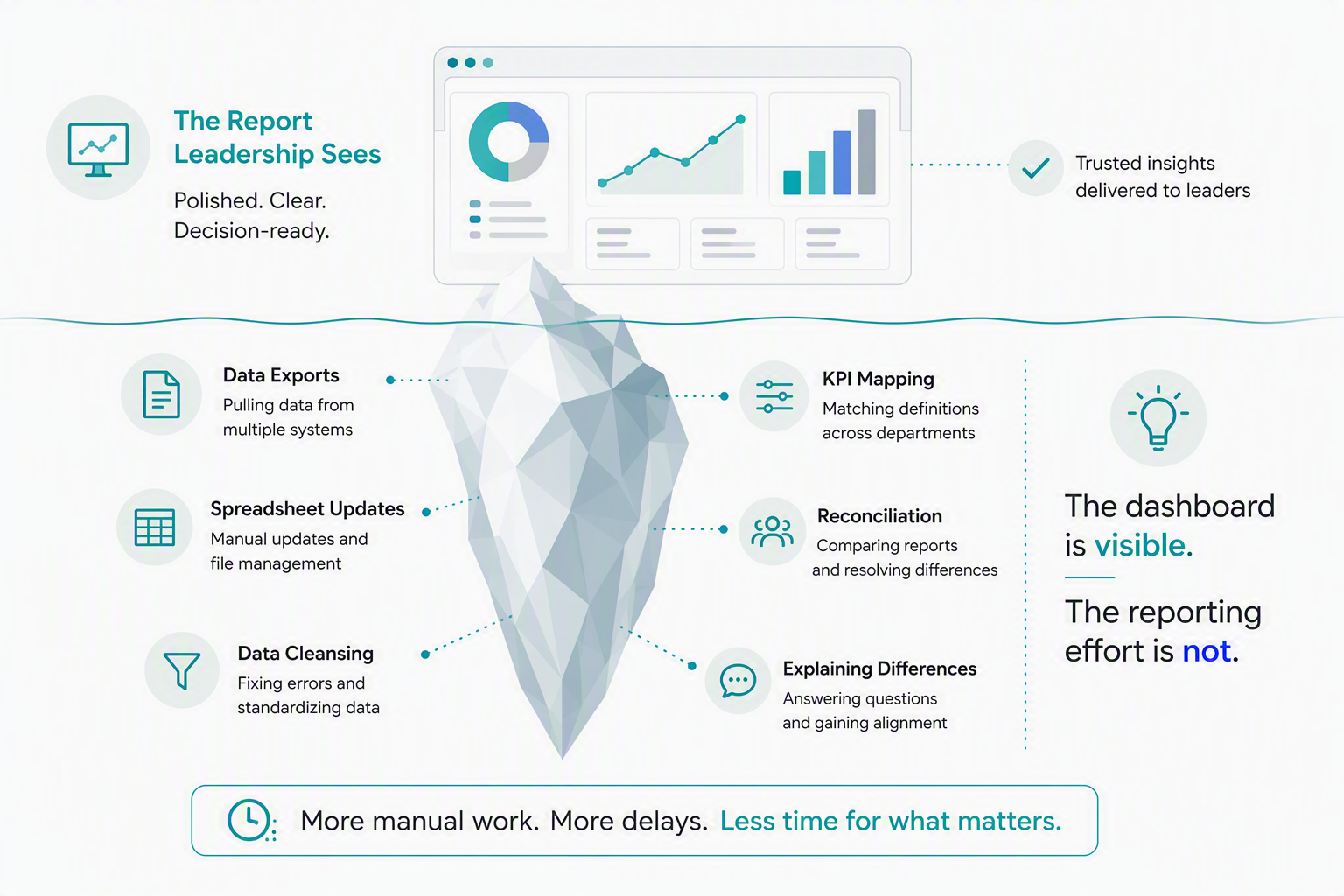
Each team may have valid information. The challenge is bringing it together consistently. Different systems, refresh schedules, calculations, and KPI definitions can produce different answers to the same question. Teams spend time reconciling reports and validating numbers before discussing what the data means.
As reporting needs expand, even a simple question can become difficult to answer. Data may need to be pulled from several systems, exported, combined, checked, and reconciled across multiple teams before it reaches leadership.
That is where healthcare analytics begins to break down.
For hospitals and medical groups, this creates some real leadership questions:
- Which number is right?
- Which system should we trust?
- Why does the same KPI look different across departments?
- Can we confidently make decisions based on this data?
This effort takes time away from analysis. Instead of identifying trends and investigating issues, teams remain focused on gathering data and resolving differences. When every question triggers more validation, insights take longer to reach leadership.
The result is not simply slow reporting. It is reduced confidence in the information guiding clinical, financial, and operational decisions.
So, does adding another dashboard solve the problem?
A new dashboard may improve information presentation, but it cannot fix what is happening underneath.
Inconsistent definitions, quality gaps, and unclear ownership will follow the data into the dashboard. The same KPI may still produce conflicting results in a more polished format.
Dashboards make data easier to see. They do not automatically make it reliable.
Before healthcare organizations invest in more reports or Power BI dashboards, they need to strengthen the foundation behind them. Otherwise, they risk creating a better-looking version of the same reporting problem.
Trusted Healthcare Analytics Starts with Governed KPIs
Before leaders can trust a dashboard, they must trust the KPIs behind it.
What does each metric mean? Where does the data come from? Who owns it? Is the same definition being used across clinical, revenue cycle, financial, and operational teams?
If those questions do not have clear answers, the organization has more than a reporting problem. It has a governance problem.
Healthcare KPI standardization creates clarity. Each critical metric needs a consistent definition, trusted source, clear owner, and transparent calculation. Healthcare data governance shows teams how data was prepared, who can access it, and where quality issues exist.
Governance should not slow decision-making. It should remove the uncertainty surrounding it. When everyone works from the same definitions, leadership conversations shift from “Is this number right?” to “What is this number telling us, and what should we do next?”
Why Healthcare Analytics with Microsoft Fabric Creates a Stronger Foundation
Creating governed KPIs is an important first step. But definitions, controls, and ownership models need a data platform that can apply them consistently across the organization. This is where Microsoft Fabric becomes relevant.
Microsoft Fabric connects data integration, engineering, storage, analytics, and business intelligence within one environment. OneLake provides a unified data layer, while Fabric Lakehouse and Warehouse capabilities organize clinical, financial, and revenue cycle data for consistent use.
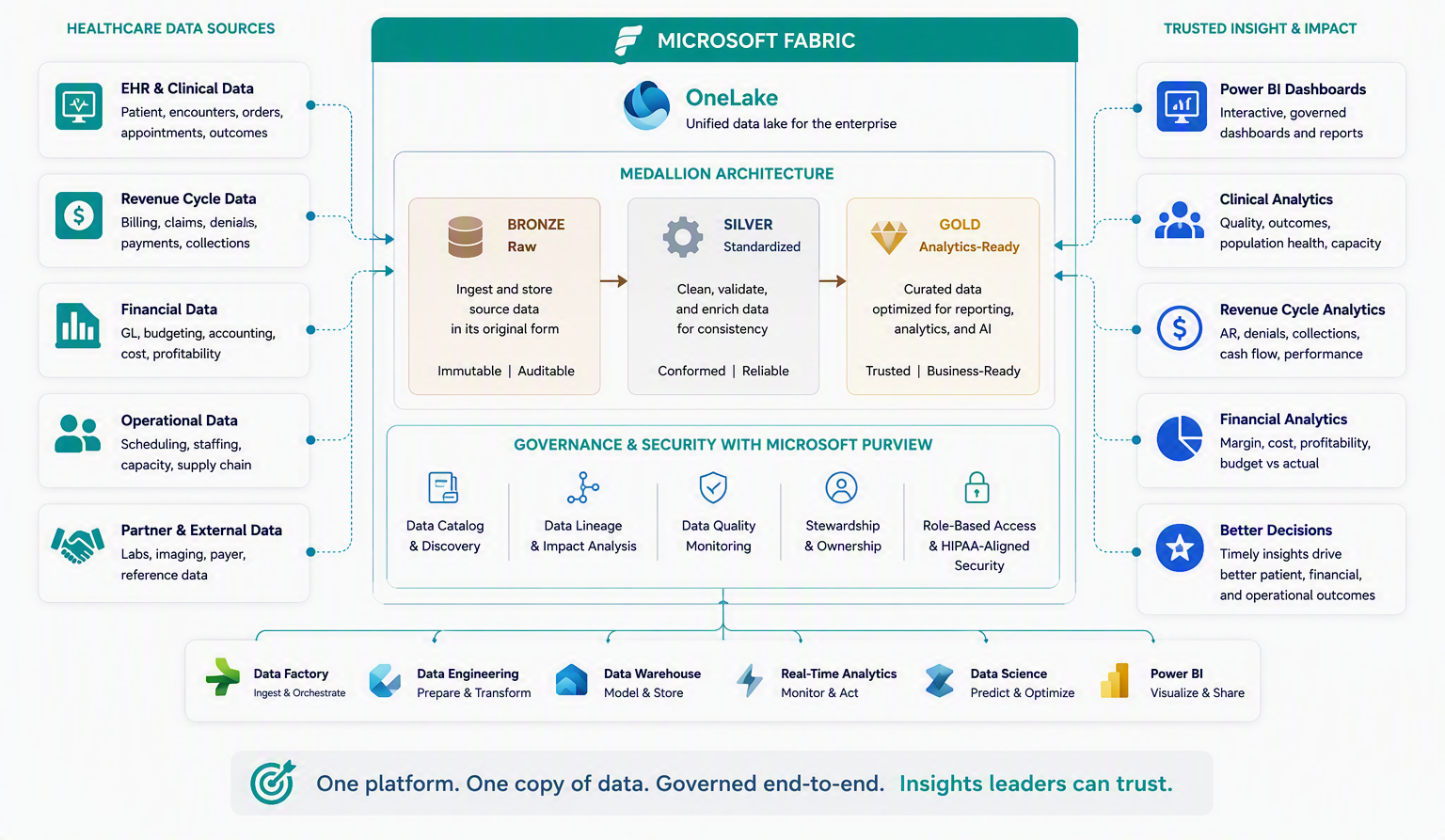
A Medallion Architecture adds structure to the process. Raw source data enters the Bronze layer, is cleaned and standardized in Silver, and becomes analytics-ready in Gold. This gives semantic models and Power BI dashboards a more reliable foundation for governed KPIs and enterprise reporting.
Microsoft Purview supports data cataloging, lineage, and data-quality oversight, helping teams understand where data came from, how it changed, and whether it is ready for decision-making. Together, these capabilities support HIPAA-aligned analytics without separating governance from the broader data strategy.
The value is not simply having everything in one platform. It is creating a connected path from source data to trusted insight. Organizations exploring the broader platform opportunity can also learn more about Microsoft Fabric for healthcare.
The Business Shift – From Reporting to Healthcare Decision Support
Trusted data changes the purpose of reporting. Instead of looking only at what has already happened, healthcare leaders can use connected clinical, revenue cycle, financial, and operational insights to guide what happens next.
A change in patient volume can be viewed alongside its operational and financial impact. Revenue cycle trends can be considered in the context of clinical activity. Leaders can identify issues earlier and understand how decisions in one area may affect another.
Reporting presents information. Decision support brings the right information together while there is still time to act.
A Practical Roadmap for Healthcare Analytics Modernization
Healthcare analytics modernization does not have to begin with a large enterprise-wide implementation. It should begin with clarity. That clarity also depends on a scalable healthcare data strategy built around decisions rather than connected systems.
Which decisions need better data? Which KPIs matter most? Where does that information currently live, and what prevents teams from trusting it?
A practical roadmap brings clinical, revenue cycle, financial, and IT stakeholders together. Organizations can then assess priority data sources, agree on KPI definitions, identify quality and governance requirements, and select high-value use cases.
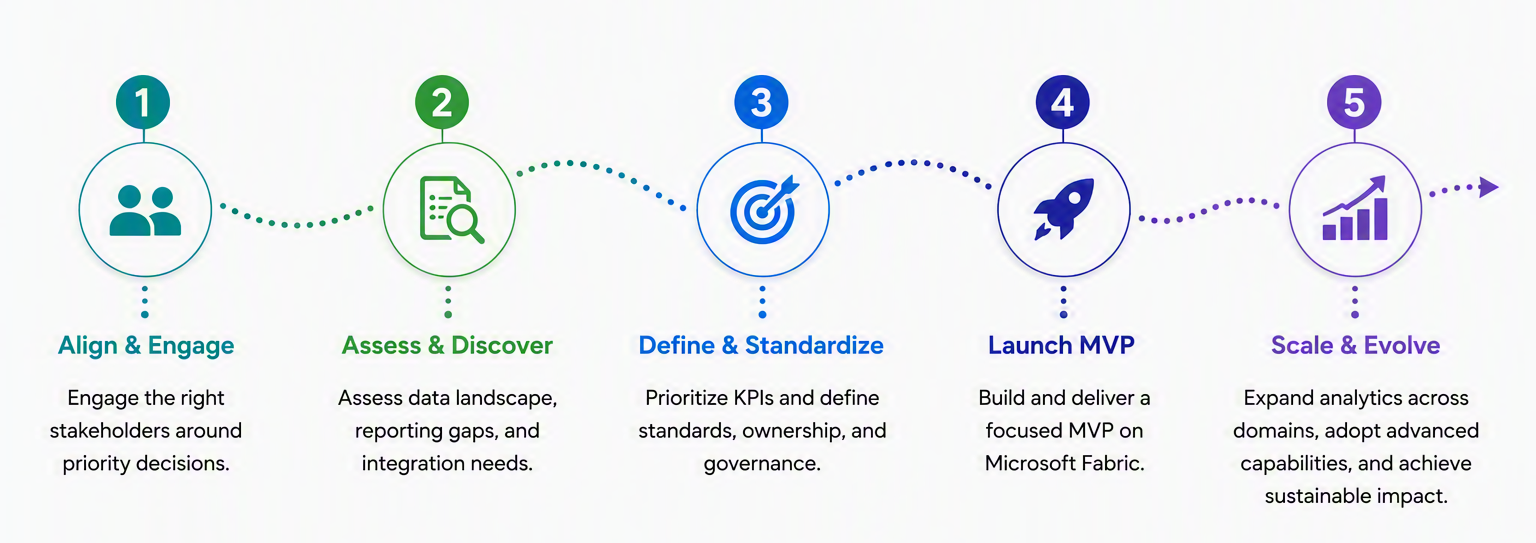
An MVP-first approach keeps the effort focused. Rather than connecting every system and building every dashboard at once, organizations can begin with a defined clinical or revenue cycle use case, establish the Microsoft Fabric foundation, and expand as needs grow.
From Fragmented Reporting to a Modern Healthcare Analytics Roadmap
A leading university medical center followed this approach when planning the modernization of its healthcare analytics environment.
Clinical and financial data was spread across Epic, two eClinicalWorks instances, IDX, and an external ACS billing partner. Reporting depended on manual reconciliation, KPI definitions varied by department, and the organization needed stronger data quality, governance, and HIPAA-aligned security.
VNB Health began with discovery, bringing clinical, revenue cycle, and IT stakeholders together to assess the environment, align reporting priorities, map critical KPIs, and identify governance requirements.
The outcome was a phased Microsoft Fabric roadmap for a unified healthcare analytics foundation. The recommended MVP focused on clinical and revenue cycle analytics, creating a practical starting point for trusted reporting and future expansion.

The lesson is straightforward: define what matters, establish trust in the data, and build forward with purpose.
Modern Healthcare Analytics Starts with Trust
Healthcare analytics modernization is not about adding more reports or moving data into another platform. It is about giving leaders greater confidence in the information guiding their decisions.
Consistent KPIs, clear ownership, stronger governance, and a connected Microsoft Fabric foundation create a practical path from fragmented reporting to trusted decision support. The goal is not to modernize everything at once. It is to begin with the decisions that matter and build from a trusted starting point.
Ready to build a trusted healthcare analytics foundation? If fragmented reporting, inconsistent KPIs, or manual reconciliation are slowing decision-making, VNB Health can help you define a practical roadmap for modern healthcare analytics with Microsoft Fabric