
Healthcare organizations don’t struggle with data due to lack of technology. They struggle because their data strategies often revolve around systems instead of decisions.
Healthcare organizations invest heavily in EHRs, analytics platforms, and reporting tools because they believe that collecting more data and building more dashboards brings clarity. In many cases, it does. However, these efforts rarely deliver true scale.
A scalable healthcare data strategy is not about how much data an organization collects or how many reports it publishes. It is about how easily teams can reuse data, trust it, and extend analytics as priorities change.
The Impact of Fragmentation on Healthcare Data Strategies
In a typical healthcare setting, data is managed across different systems, each designed for specific operational needs.
- Clinical data is stored in EHR platforms.
- Financial data lives inside billing and claims systems.
- Operational data exists within scheduling or departmental applications.
Each system provides insights in isolation, while teams build reports independently around those systems. An EHR report explains what happened during care delivery. A claims report shows what the organization reimbursed. An operations report highlights staffing metrics or throughput. Each view provides value on its own.
However, when these views remain disconnected, organizations gain visibility without coherence.
When leaders ask cross-functional questions, teams provide inconsistent or incomplete answers. Time is wasted reconciling numbers instead of interpreting them, which slows down decision-making.
With fragmented data, analytics becomes reactive. Decision-making remains manual. Visibility improves, but scale does not.
Traditional Healthcare Data Strategies Struggle to Scale
Organizations usually develop data capabilities as a series of projects. Over time, they accumulate layered data warehouses, point integrations, and isolated analytics pipelines. These architectures work well when data sources are limited, and system requirements are stable and predictable.
With new data sources, changing regulations, and shifting reimbursement models, these architectures become more complex. This complexity forces teams to revisit their initial design. Instead of extending the strategy, they end up rebuilding it.
Over time, analytics initiatives turn into cycles of rework. Pipelines multiply and metrics become inconsistent. Maintenance costs rise. Scale breaks not because of data volume, but because the strategy cannot adapt to change smoothly.
The core issue lies in the architecture. Traditional methods depend on multiple copies of data, segregated storage systems, and disparate analytics platforms. This setup hinders reuse and leads to inconsistent governance as analytical capabilities grow.
A Modern Approach to Healthcare Data Strategy
… starts from a different assumption: change is constant.
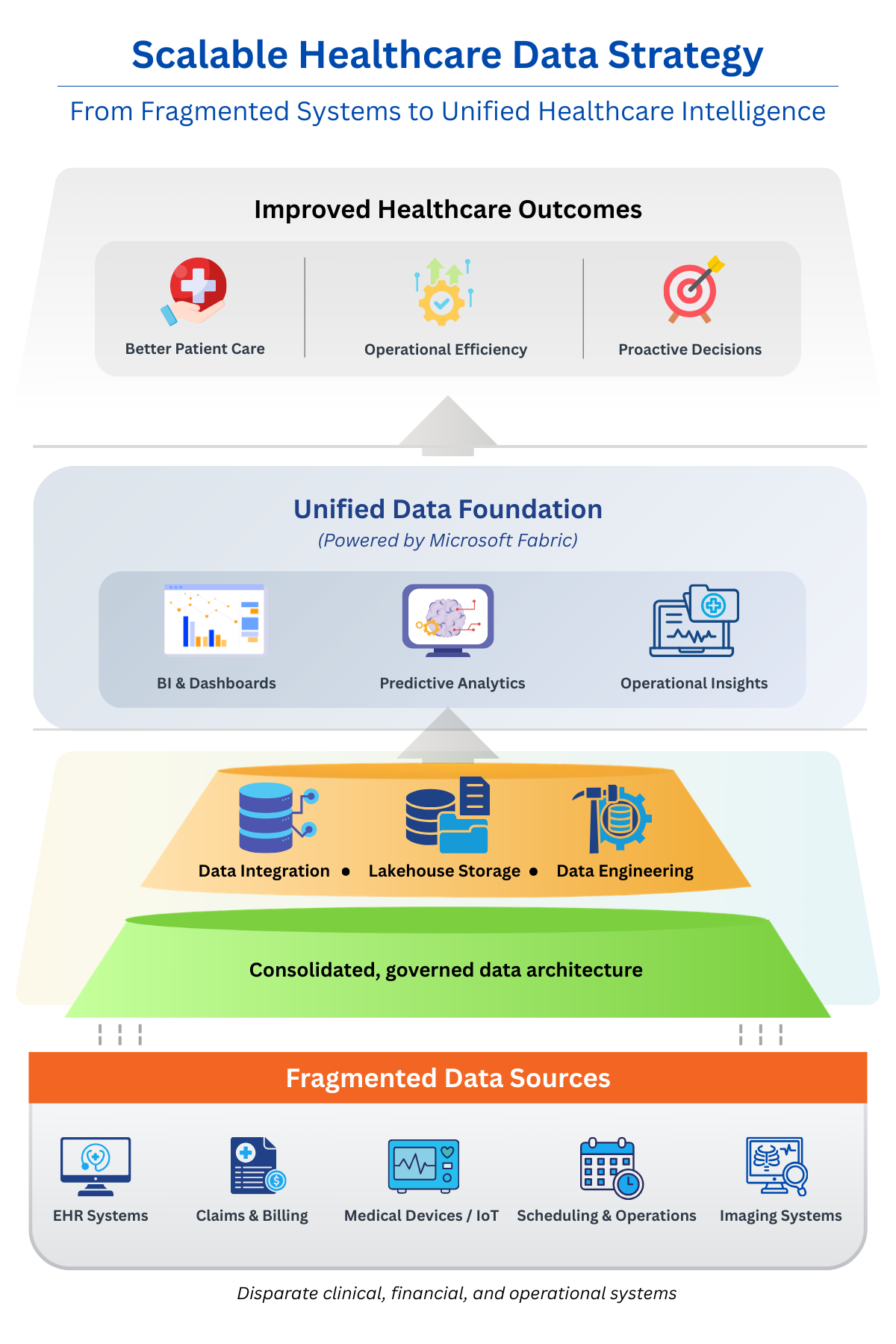
Organizations are moving away from building analytics based on rigid requirements. They are now building data foundations that encourage reuse, consistency, and flexibility as needs evolve. Instead of relying on separate pipelines, teams work with unified data models and definitions that connect different business areas.
This strategy is based on three key capabilities:
Unified data integration – Combining clinical, financial, and operational data in one system allows leaders to evaluate performance without needing to reconcile metrics across teams.
Real-time and long-term analytics – Healthcare leaders require immediate insights along with access to historical data to make quick, informed decisions.
Built-in governance and compliance – Given the sensitivity of healthcare information, the platform must reliably enforce access controls, data lineage, and regulatory compliance. This helps healthcare analytics expand securely without added risk or the need for manual supervision.
Analytics now focus on ongoing decision-making rather than just reporting. With fewer rebuilds and less fragmentation, analytics can scale as the organization grows.
Where Microsoft Fabric Changes the Equation
As priorities change and new requirements arise, the data strategy must also adapt. This is where Microsoft Fabric offers a fresh perspective.
Microsoft Fabric offers an integrated platform for data engineering, storage, governance, and analytics within one architecture. Its unified analytics foundation lets various workloads to access governed data without duplication, which eliminates the need to copy data between warehouses, lakes, and BI layers.
This design prevents metric drift, simplifies governance, and enables scalable analytics across clinical, financial, and operational areas without needing to rebuild pipelines for every new requirement.
Fabric combines clinical, financial, and operational data into a single analytics layer. This eliminates the need to redefine metrics or maintain separate pipelines as needs evolve. Teams can scale analytics without duplicating data or disrupting models. Shared semantic models and centralized governance let teams reuse reliable datasets across departments rather than rebuilding pipelines for new reports.
By creating a strong data foundation, healthcare organizations can meet diverse analytics needs, respond more quickly to leadership questions, and maintain consistency as their operations expand.

What This Means for Healthcare Leaders
Healthcare leaders should not evaluate data strategy success by the number of dashboards delivered. These metrics show activity, not scale.
A scalable data strategy focuses on flexibility by assessing how efficiently new data sources can be integrated, insights generated, and analytics expanded to support additional systems and models.
Effective data strategies make analytics reliable and reduce validation efforts, allowing organizations to focus on action. With a robust, scalable data infrastructure, organizations can more easily support innovations like AI diagnostics, predictive care, and real-time intelligence.
Turning Strategy into Action
As healthcare organizations modernize their data platforms, the most important question is not whether they can deliver reports faster. It is whether the data foundation can grow and stay cohesive without fragmenting again.
Microsoft Fabric supports this transition by allowing healthcare organizations to scale analytics with a unified, governed platform. This supports diverse use cases without requiring the core to be rebuilt as priorities evolve.
In addition to the platform capabilities, accelerating adoption is essential. To help healthcare organizations expedite their adoption of Microsoft Fabric, VNB Health provides a comprehensive suite of pre-built healthcare analytics accelerators designed to run natively on the platform. These accelerators include pre-configured data models, semantic layers, KPI frameworks, and governed dashboards covering areas such as Revenue Cycle Analytics, Financial Analytics, Clinical Analytics, and Admissions Analytics.
Leveraging a cloud-native Lakehouse architecture, these accelerators enable organizations to rapidly implement a scalable analytics framework while maintaining the adaptability required for future extension and customization as business requirements change.
A scalable healthcare data strategy does not eliminate change. With the right foundation, it grows with it.
If you’re reconsidering how your healthcare data strategy should scale, our team can help healthcare organizations design and implement Microsoft Fabric-based data foundations built for long-term adaptability. Contact us for a free assessment of your current data architecture and learn how Microsoft Fabric can help future-proof your analytics.