
In case you have been keeping up with the discussions about AI in healthcare, you might have observed how quickly the terminology changes. First, it was predictive AI. Then, at HIMSS 2025, generative AI was the topic of discussion, and everyone spoke about how it could summarize notes, answer questions, and speed up daily tasks.
During HIMSS 2026, the emphasis was no longer on what AI can do. It shifted to what tasks AI can actually handle. That’s when Agentic AI started to appear in conversations.
In fact, agentic systems have existed over time. Many of them have been operating behind the scenes in IT, finance, HR, and other business departments for years. So, its emergence in healthcare wasn’t particularly unexpected. Unlike predictive and generative AI, which follow established rules or prompts, agentic AI can take initiative and adjust to its environment.
Predictive to Agentic: The Development of AI in Healthcare
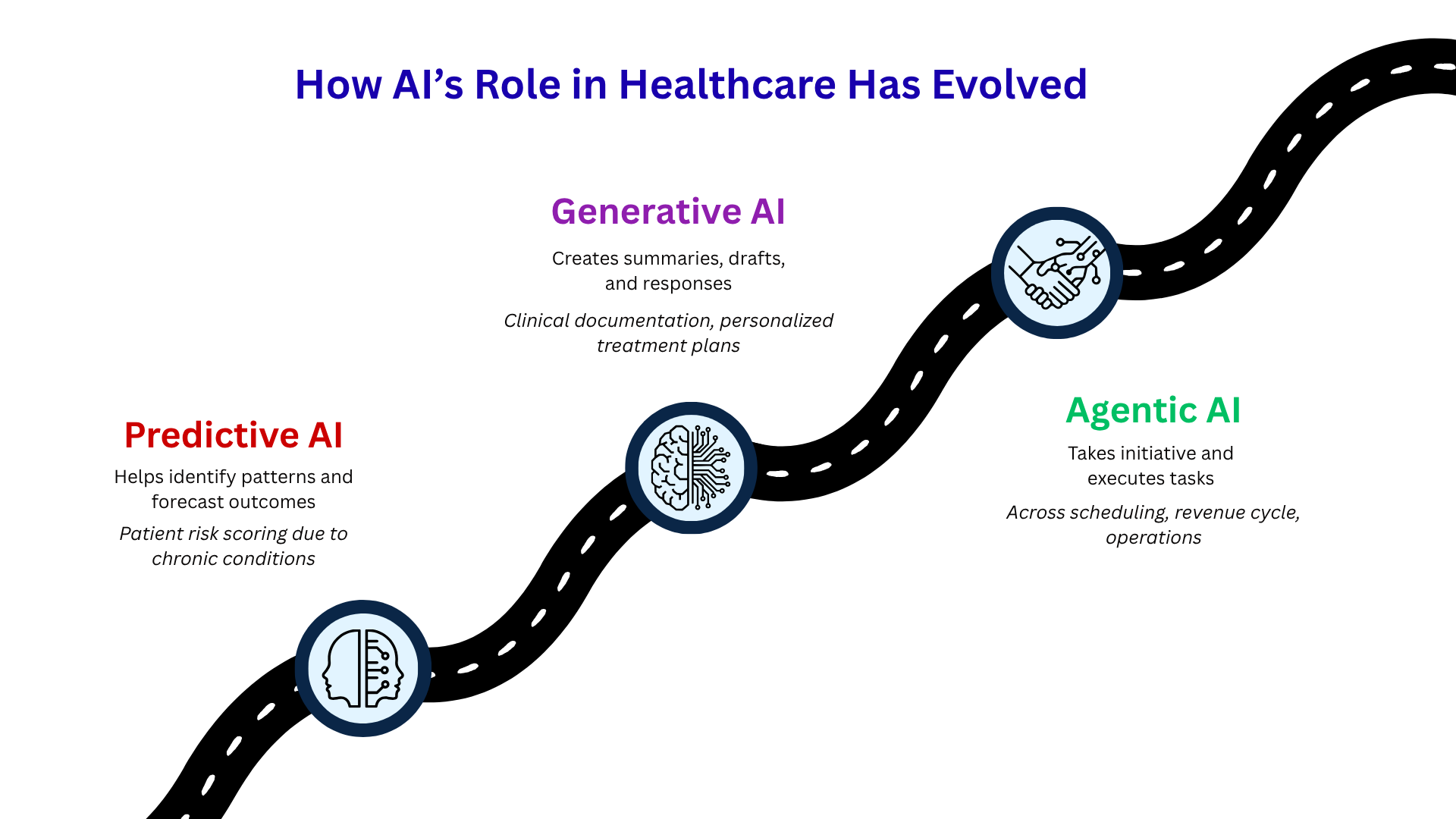
To understand why agentic AI is gaining much attention now, it is important to understand how healthcare AI has evolved over the years.
For quite some time, AI in healthcare was largely about prediction – analyze historical data and flag risks, forecast trends, and more. While they were useful, it was mostly passive. With generative AI, it extended into everyday workflows where it could summarize, draft, and understand huge volumes of data easily. This was a huge leap for clinical teams who were overwhelmed with documentation and administrative work.
Agentic AI takes it one step further. Besides assisting in decision-making or generating outputs, it operates within defined boundaries. Agentic systems observe, decide, and act, reducing coordination and handoffs between systems and teams.
This progress marks an important milestone in healthcare. Agentic AI signals a broad change in how the industry approaches automation and decision-making.
The Shift in AI Conversations at HIMSS 2026
While discussions about AI in the past was around possibilities and potential, this year the conversation was much more practical on where AI is being implemented, what value it is delivering, and how organizations are integrating AI into their processes. However, as organizations start seeing AI operate across systems and teams, the next question is how it is governed, monitored, and controlled at scale.

Why Enterprise Governance is Essential for Agentic AI
AI is moving beyond productivity tools or copilots to integrate into daily healthcare workflows, raising questions about trust, oversight, and boundaries.
Conversations like “How will these systems be governed once they operate inside existing clinical, care team, payer, and provider workflows? How do organizations stay in control as AI integrates across departments and systems?” show that governance is no longer being treated as an afterthought. It is being recognized as a necessary foundation for running agentic AI in enterprise environments.
The goal is simple: to be clear about where AI can and should act independently, and where humans must remain firmly in the loop.
This matters because healthcare workflows are deeply interconnected. Consider this scenario: an AI agent automatically reschedules appointments when a clinician’s availability changes. While this seems helpful, imagine the chain reaction it can trigger to downstream systems – patient notifications, eligibility checks, staffing plans, billing and authorization workflows.
If a patient is notified incorrectly, who owns that outcome? If an authorization expires because a downstream system wasn’t updated on time, where does the accountability sit?
When AI becomes a part of an interconnected workflow, even small actions carry significant consequences. That’s why ownership, visibility, and accountability become so important. Enterprise governance is all about ensuring that as AI starts taking on more initiative, organizations can retain clarity, control, and confidence in how work gets done.
Where Healthcare Goes Next with Agentic AI?
HIMSS 2026 was a milestone for healthcare, with AI shifting from trial to responsible use and shaping workflows. The focus is now on sustainability.
Agentic AI offers powerful capabilities, but it demands robust responsibility that goes beyond isolated solutions. The question of whether healthcare is ready for this shift still remains open. Readiness isn’t about adding more AI; it’s about having the right structures, guardrails, and foundations that allow AI to operate safely at scale. Governance is part of the answer, but it’s far from being the only one!
At VNB Health Solutions, we work closely with healthcare organizations to facilitate their transition, supporting AI strategy development, responsible implementation, and enterprise preparedness across both clinical and operational environments. As agentic AI moves from concept to reality, having the right foundations in place will matter more than the technology itself.
Our upcoming article will take a closer look at one key foundation: interoperability. Regardless of how advanced AI gets, its influence will ultimately rely on the ability of healthcare systems to connect, share information, and collaborate effectively.